These tools were particularly useful for intricate designs, where exact placement of each flower was necessary to achieve the desired aesthetic. By securing the stems in a flower frog, arrangers could create complex displays that maintained their appearance over time.
4. Key Clues That Confirm It’s a Flower Frog, Not a Weapon
To confirm the identity of your metal object as a flower frog, look for these features:
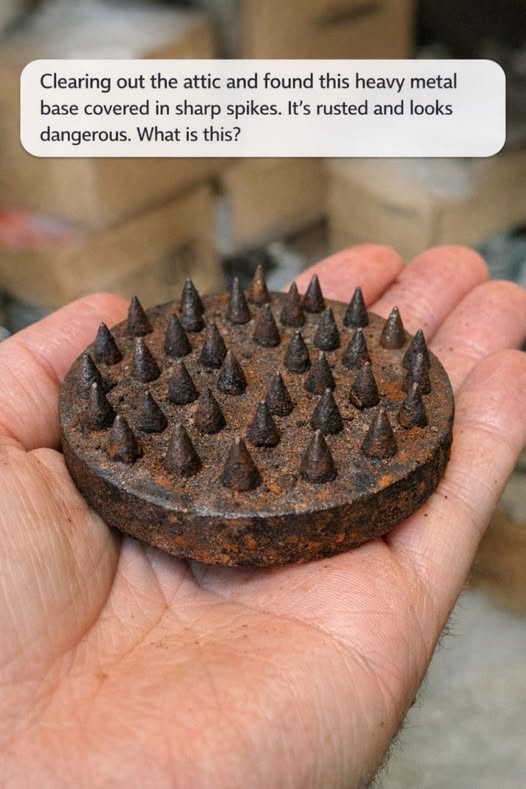
Evenly spaced spikes designed to hold flower stems.
A broad, stable base, often flat or rounded.
Possible manufacturer markings or stamps indicating its origin as a floral tool.
The presence of a flat, solid base with uniformly sharp spikes is a strong indicator that this object is indeed a flower frog and not some other spiked implement.
5. Other Possibilities (and How to Rule Them Out)
While a flower frog is the most likely identity, other possibilities exist, such as an industrial tool component, a decorative item, or part of a defensive trap. Examine the construction:
Industrial components often have threaded sections or attachment points.
Decorative items usually feature aesthetic elements beyond simple spikes.
If these features are absent and the design is simple and utilitarian, it’s likely a flower frog.
6. How Old Is Your Flower Frog? Dating Clues
Factors that can indicate age include:
Degree of rust (older frogs are often more corroded).
Design style (older models may be heavier or more ornate).
Material (vintage frogs are typically made of heavy metals like lead or cast iron).
Maker’s marks or stamps that provide information about production era.
7. Collectible Value of Vintage Flower Frogs
The value depends on age, condition, rarity, and design. Pristine examples with unique designs or markings from well-known manufacturers are more desirable. Prices range from a few dollars for common examples to several hundred for rare or particularly beautiful pieces.
8. Safe Handling Tips
Wear gloves to avoid injury.
Use a cloth or pad underneath to protect surfaces.
If spikes are very sharp, consider blunting tips with a file or covering them.
Store in a secure location away from high-traffic areas.
9. Cleaning and Restoring a Rusted Flower Frog
Brush off loose rust with a wire brush. Avoid vigorous scrubbing.
For deeper cleaning, use rust remover or a mixture of vinegar and baking soda. Soak for a few hours, then scrub gently.
Dry thoroughly and apply a clear sealant or wax to prevent future rusting.
Test cleaning solutions on a small area first.
10. Creative Ways to Reuse or Display
Although traditional floral arranging with flower frogs has diminished, they can be repurposed:
As conversation pieces on a shelf or in a curio cabinet.
As pencil holders or organizers for small tools and art supplies.
Incorporated into vintage or industrial-themed décor for texture and interest.
11. When to Discard
Dispose of the flower frog if:
Severe corrosion compromises structural integrity.
Spikes are bent or broken, making it unsafe.
Rust is extensive and poses a health hazard.
In such cases, recycling the metal is the safest option.